Steinbrener/Dempf & Huber
Crazy Horse - a disruptive trap
Steinbrener/Dempf & Huber is an artists’ collective founded in 2001, comprising the sculptor Christoph Steinbrener, the photographer and graphic designer Rainer Dempf, and the architect Martin Huber.
In their works, the artists explore the relationship between civilisation and nature, changing social structures and constellations, the commercialisation of urban space in highly civilised societies, and the resulting economic and social circumstances. The artist trio’s meticulously planned projects are primarily staged in public spaces.
For several years now, Steinbrener/Dempf & Huber have also been running the ‘Wandzeitung’ in the shop windows of their studio, located in a side street in Vienna’s 2nd district.
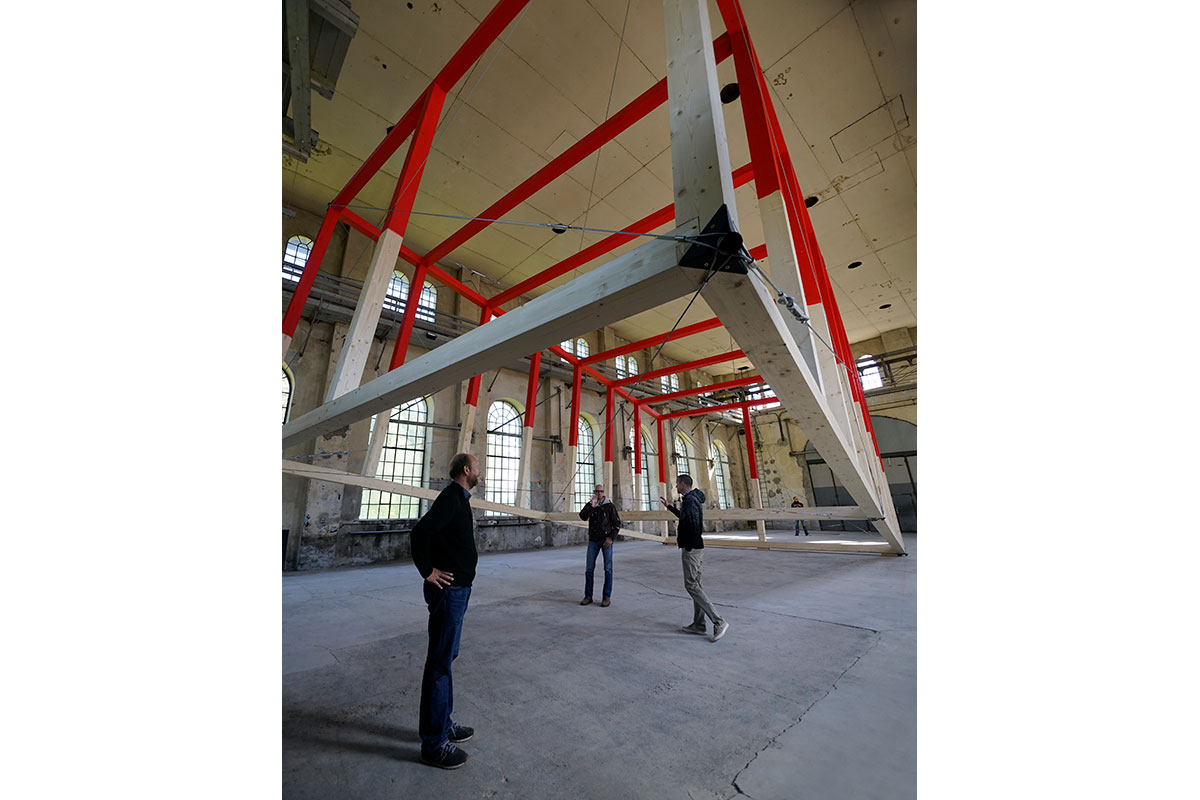
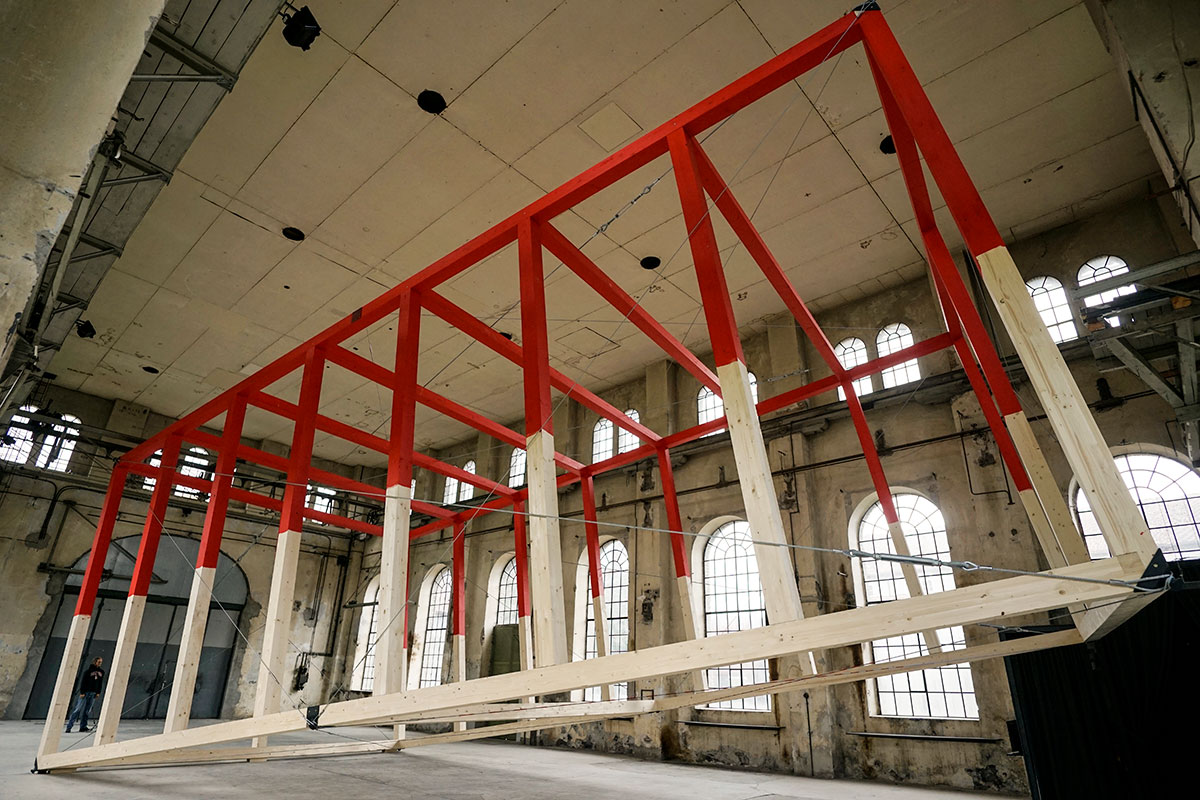
For the exhibition at Kunstraum Dornbirn, two projects will be realised: one in the assembly hall and, simultaneously, in Dornbirn’s public urban space.
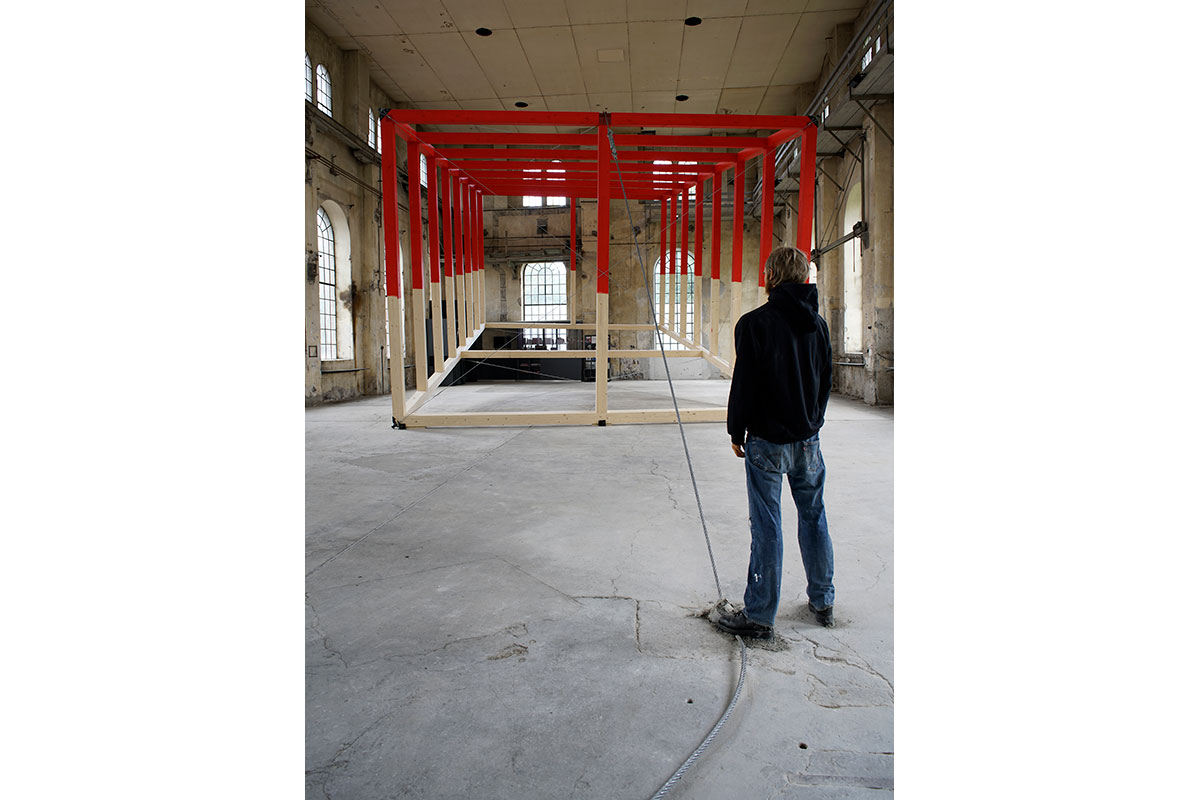
The installation ‘Crazy Horse, a disruptive trap’, on display from September 2017 at Kunstraum Dornbirn, surprises visitors with speculative views of the hall on a reduced scale. The artists present an architectural interpretation of the assembly hall as a room-filling wooden structure, which, on closer inspection, reveals itself to be a multi-layered and ambiguous work.
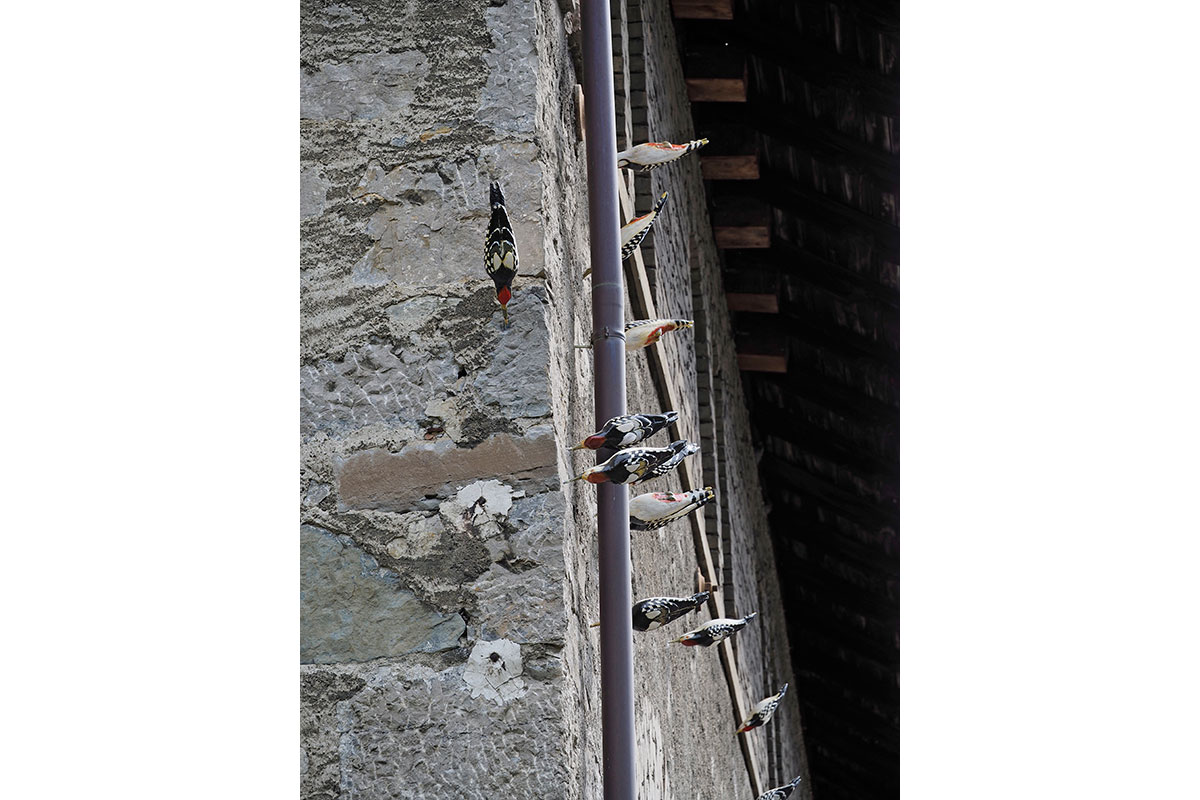
In parallel, the project ‘Critical Mass’, an epidemic-style installation for Dornbirn, is being realised in public spaces. Swarms of black woodpeckers – like projectiles – are embedded in façades at selected locations throughout the city of Dornbirn. On the one hand, the project addresses themes such as the relationship between over-civilised humans and uncontrollable nature; on the other hand, the swarm functions as a metaphor for collective intelligence, that is, group or swarm intelligence. Swarm intelligence is believed to have the potential to transform society and markets. Examples of this include smart mobs (flash mobs) and the Critical Mass movement. Natural processes are placed here in direct correspondence with social developments.
Public projects and exhibitions
In 2005, as part of the founding project ‘Delete!’ in Vienna’s Neubaugasse, all commercial signage – such as shop signs and advertising posters – was covered in yellow. The subsequent ‘Copy/Paste’ project series took the opposite approach: advertising, company logos and PR posters were made explicitly visible, but contextually shifted and deliberately misplaced; for example, in 2007, when the Ursuline Church in Linz was ostensibly converted into a Starbucks branch (‘Pass the Buck’).
In 2008, ‘Jesuitenkosmos’ made Andrea Pozzo’s ceiling paintings in Vienna’s Jesuit Church disappear beneath a contemporary and secular celestial construction. This method of displacement led to the 2009 exhibition ‘Trouble in Paradise’ at Vienna’s Schönbrunn Zoo, in which Steinbrener/Dempf & Huber installed foreign objects (cars, barrels of toxic waste, railway tracks) in the animal enclosures, thereby exploring the confrontation between nature and civilisation.
The exhibition ‘Freeze!’, which opened in June 2012 at the Natural History Museum in Vienna, was an attempt to replace the romanticised view of animal representation with a realistic perspective in light of today’s conditions of growing civilisation. In doing so, Steinbrener/Dempf & Huber revitalised an old scientific display tool: the diorama. In collaboration with the museum’s taxidermists, they presented snapshots of wild animals in urban settings – scenes one would otherwise only encounter in online videos or accounts of exotic travels.
In 2014/15, as part of the project ‘To Be in Limbo’ at the Jesuit Church in Vienna, the artists made a gigantic rock appear to float, which can be interpreted as an attempt to visualise unsettling socio-cultural developments within religions. This installation was subsequently exhibited at St Katharine’s Church in Hamburg.
In 2015, the artists’ collective affixed an ibex to the top of the 43-metre-high Bismarck Monument in Hamburg, thereby addressing the resurgence of German nationalism – the work was titled ‘Capricorn Two’.
In 2016, the Viennese artists’ collective unveiled, almost simultaneously, two ‘commentaries’ on their city’s architecture that were visible from afar: the sculptures ‘Sign of the Times’ (on the façade of the InterContinental Hotel) and ‘Lunch Atop’ (on the roof of a Viennese high-rise). Above the rooftops of the 9th district, near Franz-Josefs-Bahnhof, an 18-metre-long I-beam juts out into the street. Five people are sitting on it, looking completely relaxed.
The sculpture, entitled ‘Lunch Atop’, is a replica of an iconic photograph taken by Charles C. Ebbets in 1932, a symbol of progress and daring in construction. The sculpture serves as a symbol and a landmark visible from afar. It is also a heartfelt tribute to those who bring such structures to life and who often go unnoticed by the public: the workers.
Steinbrener/Dempf & Huber in an interview with Armin Thurnher
The Diorama Trio
Fahim Amir “You need a weatherbird to know which way the wind blows”
You need a weatherbird_E